New Batch Staring - November 14, 2026
Internal Auditor Training on ISO 42001
AI Management System
To equip professionals with the practical knowledge and auditing skills required to assess and audit an Artificial Intelligence Management System (AIMS). Through a structured 16-hour program, participants will learn AI governance concepts, risk-based auditing approaches, and compliance frameworks to help ensure AI systems remain trustworthy, ethical, and aligned with international standards.

Talk to our expert
OR
Candidates from outside India will receive our call on WhatsApp. Please Click here to save our number to recognize us as known and solicited caller.
Trusted by executives from global enterprises











Who should Participate?
This course is well suited for:
- Internal Auditors and IT Auditors
- AI Governance and Compliance Professionals
- Risk Management and Assurance Teams
- Information Security and Privacy Professionals
- AI/ML Project Managers and Technology Leaders
- Compliance Officers and Governance Teams
- Professionals responsible for AI risk oversight and regulatory compliance
- Organizations implementing or planning to implement AI governance frameworks
Learning Objective
By the end of this course, participants will:
- Understand the principles and requirements of ISO/IEC 42001:2023
- Learn the structure and implementation approach of an Artificial Intelligence Management System (AIMS)
- Identify and assess AI-related risks, controls, and governance challenges
- Develop the skills required to plan and conduct AI internal audits
- Understand AI lifecycle governance, monitoring, and compliance requirements
- Learn how to evaluate AI transparency, explainability, fairness, and accountability
- Gain practical knowledge of risk-based auditing techniques for AI systems
- Strengthen audit reporting and corrective action processes for AI governance
Internal Auditor Training on ISO 42001- AI Management System
Topics Covered
- Fundamentals of AI, ML, Deep Learning & LLMs
- Understanding AI-specific risks and governance challenges
- Bias, hallucination, explainability & model drift concepts
- Why AI auditing differs from traditional IT auditing
- Introduction to ISO/IEC 42001:2023
- Understanding the Artificial Intelligence Management System (AIMS)
- Alignment with ISO 27001, ISO 27701 & ISO 38500
- AI governance and compliance framework overview
- Context of the organization & AIMS boundaries
- Leadership roles, responsibilities & AI policy
- AI objectives, risk management & planning requirements
- Governance and accountability requirements
- Defining AIMS boundaries
- Identifying AI lifecycle scope
- Evaluating third-party AI dependencies
- Practical scoping exercise and discussion
- AI operational controls and governance
- Competence, awareness & documentation requirements
- AI risk assessment & impact assessment processes
- Monitoring, internal audits & continual improvement
- AI policies and governance controls
- Internal organizational responsibilities
- AI resource management & competencies
- Cross-functional governance structures
- AI impact and ethical risk assessments
- AI system lifecycle governance
- Data quality, provenance & privacy controls
- AI deployment, monitoring & retirement controls
- Reviewing AI impact assessment reports
- Identifying gaps in compliance & bias controls
- Evaluating validation and monitoring mechanisms
- Practical AI risk analysis activity
- ISO 19011 auditing principles for AI systems
- Managing AI audit programs
- Audit planning & scope definition
- Interviewing technical and business stakeholders
- Developing AI-focused audit questions
- Mapping ISO 42001 controls to audit evidence
- Identifying measurable compliance indicators
- Testing governance and operational controls
- Drafting AI audit checklists
- Defining evidence requirements
- Control validation exercises
- Group-based practical workshop
- Audit evidence collection techniques
- Document reviews & log inspections
- Stakeholder interviews & system demonstrations
- Handling explainability challenges during audits
- Evaluating audit observations and evidence
- Identifying conformity and non-conformity
- Mapping technical gaps to ISO controls
- Reporting governance and operational issues
- Simulated AI audit interview exercise
- Identifying documentation and governance gaps
- Reviewing AI monitoring and retraining processes
- Practical evidence analysis activity
- Structure of an effective NCR
- Writing evidence-based audit findings
- Root Cause Analysis (RCA) review
- Evaluating corrective action plans
- Final assessment and knowledge review
- Discussion on real-world audit scenarios
- Certification guidance and next steps
- Course conclusion and Q&A session
Duration | 16 Hours |
Mode of Delivery | Online (Weekend Classes / Live Instructor-led) |
Batch Schedule | Upcoming Batch: 14th November - 22nd November 2026 Time: |
Trainer | Mr. Pradeep C S |
You will receive |
|
Assessment Schedule, Structure and Passing Requirements | Assessment shall be conducted at the end of instructor-led training Date: 28th November 2026 Timing: Duration: 30 Minutes |
Fees | Indian Participants (Resident Indian Citizens): ₹ 7,500 (All Inclusive) International Participants (Foreign Nationals / NRIs): |
Training Partner | SMC Services |
| How to register? | Click here to Register |
Know the Trainer

Pradeep C S
Cybersecurity Expert
Having worked extensively with Fortune 100 clients, Pradeep has successfully established and managed enterprise-wide risk postures across critical domains such as Operational Risk, Compliance Risk, and Technology Risk. Their experience spans multiple industries including BFSI, ITES, Telecom, and Healthcare, providing a well-rounded and practical perspective on real-world challenges.
A recognized expert in IT Governance, Business Continuity (BCP/DR), and compliance frameworks, Pradeep has hands-on experience in achieving and maintaining certifications such as PCI DSS, SOC 2, HIPAA, GDPR, and ISO 27001.
Certification
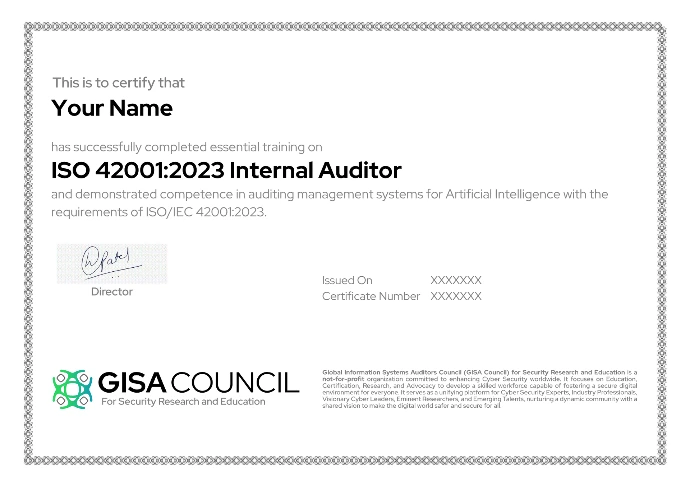
Upon successful completion of Internal Auditor Training on ISO42001:2023, the candidate will be awarded a certificate of completion from GISA Council for Security Research and Education.