New Batch Starting from 18th October 2026
Credential to launch your #CyberCareer
Data Privacy Officer
The Data Privacy Officer course is a professional training and certification
program designed to provide in-depth knowledge of data privacy, data protection
regulations, and compliance frameworks such as GDPR and the DPDP Act. This
course helps professionals understand privacy governance, risk management, data
breach handling, privacy impact assessments, and the responsibilities of a Data
Protection Officer.

Talk to our expert
OR
Candidates from outside India will receive our call on WhatsApp. Please Click here to save our number to recognize us as known and solicited caller.
Trusted by executives from global enterprises












Career Prospects
The different job profiles a professional can enter with Data Privacy credential:
• Data Privacy Officer
• Privacy Consultant
• GRC Consultant
• Information Security Officer
• Compliance Manager
• Privacy Auditor
• Risk & Compliance Analyst
• Data Governance Specialist
• Cybersecurity Consultant
• Vendor Risk Assessor
• Regulatory Compliance Specialist
• Privacy Program Manager
• IT Governance Professional
• Security & Privacy Analyst
Who should earn Data Privacy Credential?
Data Privacy Credential is well suited for:
- IT Auditors
- Information Security Professionals
- Compliance Officers
- Risk Managers
- GRC Consultants
- Internal Auditors
- ISO 27001 Professionals
- Cybersecurity Professionals
- Legal & Governance Teams
- Data Protection Officers (DPOs)
- Privacy Consultants
- Vendor Risk Professionals
- Data Governance Professionals
- Banking & Financial Sector Professionals
- Students aspiring to build a career in Privacy & Compliance
- Professionals handling sensitive or personal data
Data Privacy Officer Course Details
Topics Covered
- Understanding personal data in business context
- Data lifecycle and high-risk processing activities
- Overview of DPDP Act & GDPR (99 Articles)
- Evolution of privacy law in India
- Applicability, key principles, and lawful basis. (consent-based default under DPDPA vs. six lawful bases under GDPR)
- Roles and responsibilities (Data Fiduciary/Controller, Significant Data Fiduciary, Processor, Data Principal/Subject)
- Key definitional differences: DPDPA vs. GDPR terminology and scope (digital vs. all personal data, extraterritorial application
- Designing privacy governance structure and roles (DPO vs. mandatory-only-for-SDF nuance under DPDPA)
- Building privacy strategy, policies, and procedures
- Embedding Privacy by Design into operations
- Aligning privacy program with ISO/IEC 27701 (PIMS) and ISO/IEC 27001.
- Significant Data Fiduciary (SDF) obligations: DPIA, audits, data localisation restrictions
- Breach and Penalties as per DPDP Act (₹250 crore cap, Data Protection Board of India process)
- Data discovery and classification
- Creating data inventory and data flow mapping
- Managing data lifecycle (collection to disposal)
- Maintaining Records of Processing Activities (RoPA)
- Retention, archival, and deletion practices
- Data minimisation and purpose limitation checks during mapping
- CASE STUDY And Practical Workshop.
- Consent management and notice design (itemised, clear, specific notice requirements under DPDPA)
- Cookies and tracking mechanisms
- Role of Consent Manager under DPDPA and technical/registration requirements
- Handling data subject/principal rights (access, correction, deletion, grievance redressal)
- Designing DSAR workflow and response process (timelines under DPDP Rules 2025)
- Special provisions for children's data and persons with disabilities (verifiable parental consent)
- Identifying privacy risks in systems and processes
- DPIA / Privacy impact assessments (when and how for SDFs)
- Legitimate use / lawful basis evaluation
- Cross-border data transfer considerations (Section 16 government notifications, blacklist approach vs. GDPR adequacy/SCCs)
- Privacy risk in emerging tech: AI/ML, cloud, IoT — data minimisation for AI, consent architecture for GenAI
- Data breach identification and response
- Notification requirements and timelines (72-hour-style urgency, Data Protection Board reporting)
- Vendor risk assessment and due diligence
- Data Processing Agreements (DPA) and monitoring
- Building an incident response plan and post-incident lessons-learned process
- Privacy audit planning, KPIs/metrics, and continuous compliance monitoring
- Work Shops on Incident Management and Practical TPRM in Data Protection Perspective
- Building organisation-wide privacy awareness and training programs
- Preparing for regulatory audits and Data Protection Board inquiries
- Case studies: GDPR enforcement actions and lessons for DPDPA compliance (e.g., consent/transparency failures, cross-border transfer fines)
- DPDPA compliance roadmap and 2027 deadline readiness planning
Duration | 12 Hours |
Mode of Delivery | Online (Weekend Classes / Live Instructor-led) |
Batch Schedule | Upcoming Batch : 18th October, 24th-25th October 2026 IST: 5:30 PM - 09:30 PM |
Trainer | Kiran Sawant |
You will receive |
|
Assessment Schedule, Structure and Passing Requirements | Assessment shall be conducted at the end of instructor-led training Date: 31st October 2026 Timing: 8:00 PM - 8:30 PM IST 30 MCQs carrying 1 mark each Passing Requirement: 60% |
Fees | Indian Participants (Resident Indian Citizens): ₹ 5,900 International Participants (Foreign Nationals / NRIs): |
Training Partner | SMC Services |
| How to register? | Click here to Register |
Know the Trainer

Mr. Kiran
Kiran is an Approved Lead Auditor for ISO/IEC 27001, ISO/IEC 27701, ISO/IEC 42001, and ISO 9001. He has successfully supported numerous organizations in implementing and maintaining Information Security Management Systems (ISMS) and Privacy Information Management Systems (PIMS), enabling them to achieve certification and enhance their overall cybersecurity maturity.
His expertise spans major cybersecurity regulations and frameworks, including SEBI Cybersecurity & Cyber Resilience Framework, RBI Cyber Security Guidelines, IRDAI Information & Cyber Security Guidelines, CERT-In Directions, GDPR, HIPAA, DPDPA, NIST Cybersecurity Framework (CSF), and NIST SP 800-53. He specializes in risk assessments, governance, security audits, compliance management, and cybersecurity program development.
Recognized for his practical approach and strong technical expertise, Kiran combines industry best practices with real-world experience to help organizations improve governance, manage cyber risks, strengthen compliance, and build resilient cybersecurity programs.
Certification
(Data Privacy Officer Credential)
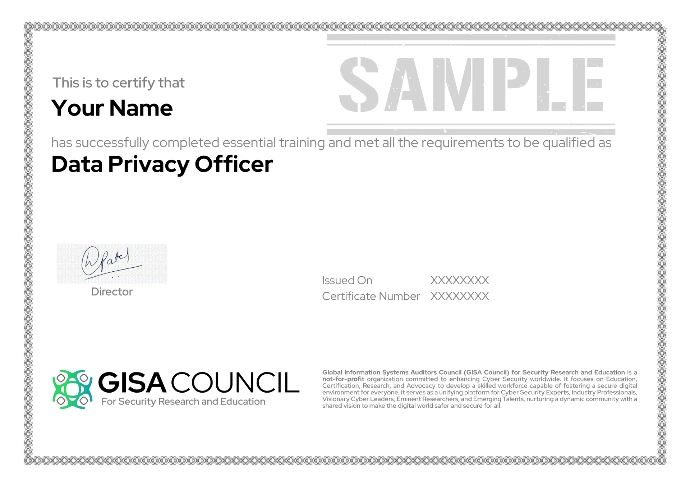
On successful completion of training and fulfilling assessment criteria, the candidate will be awarded a certificate which will entitle the candidate to be a GISA Council Certified Data Privacy Officer.